

Live free yoga

Liberated living through the sadhana of yog; enlivened realisations by the grace of the Guru.


1 Comment

of Alignment and Misalignment on Lunar Eclipse


Last night was full moon and lunar eclipse, it was also Kartik Purnima, Dev Deepavali and Gurpurab. Yes, a pretty auspicious time for many. Yogis to purohits to devotees all use this period to meditate, worship, shower adulations or pray, each according to their own understanding and devotion, as do the lovers of astronomy. I was fortunate to be in Tubac, Arizona for yesterdays event experience, with clear cloudless skies, no light pollution and an unhindered open horizon. As the shadow of the earth progressed over the bright full moon and cloaked the earth with darkness, the stars shined ever so much more brilliantly until the moon now totally eclipsed, turned crimson. Much to be grateful about.

First the alignment

As a yog practitioner, I have for many decades now viewed an eclipse as an alignment of the earth, the moon and the sun according a unique opportunity to align those centres in our own body that correspond to them. The Vedic pind-brahmand philosophy lays much emphasis on the microcosm carrying in entirety the blueprint of the macrocosm and while some revere the external others turn their awareness inwards at such moments using the event to take a leap to understand the universe within.

Before I go further there’s something I need to make clear.  I always write propelled by my own experience and realisations strongly believing that no sadhak should take as absolute others realisations. The layers of the mystical are profound and the joy of self discovery can never be understated. Texts and philosophical literature are someone else’s Truth and have only an intellectual value for me and easy to disregard if they don’t pass my self scrutiny. We each one of us have to find our own truth without a need for validation, I sincerely believe. To move on on this path of self discovery with confidence towards what makes us truly happy all we need is a will to do so and the tools to take us forward appear magically. Of course all results are greatly influenced by the fruits of our past karma and present personal efforts.

Here I will note down some musings on these physical eclipse occurrence and how I understand it to affect our body, emotions and mind. These applied realisations have greatly enabled me to bring balance in my life. I have also included a link to a meditation I recorded after this event at the end of this section.

As mentioned earlier during an eclipse, whether full or partial, there is a corresponding full or partial alignment of the sun, the earth and the moon and this reflects in our body in different ways, I have found. Our left and the right naadis in yogic terms the Ida and Pingala correspond to the Chandra (moon) and Surya (sun), connecting to the two polarities in our brain- the right and left hemispheres. The earth corresponds to our mool prakriti, the innate nature of our body, While consciously aligning these spheres during the eclipse we enable ourselves to flow with the circadian rhythm of the universe reducing conflict in our emotional and mental body- the manomaya kosha. Living without conflict with nature ones nature becomes that of stillness and the physical body receives the benefit of health of such peaceful living without stress.

Another realisation I experienced is that of the moon, the sun and the earth aligned along the spine. The moon in the Agnya Chakra indicating the mind, the Sun in the Anhad Chakra as distributor of Pran and the earth on the muladhar representing everything physical, earth, water, fire air and the space occupied when alive, in death all these return to the source.

Finally, as the moon corresponds to the mind, and it is well known how the lunar cycle effects our mind, when the shadow of the earth passes over the moon enveloping it fully and then the moon reemerges as the shadow passes, it as if a veil is removed, a veil of ignorance and the mind full of awe rebirths into a clarity facing the brilliant sun. This outer light is reflected in the inner transformation of the yogi practitioner.

click this 👉🏽 Practicing Alignment on Eclipse Days


Misalignment Galore

-my God/Guru is greater than yours

Of course after this wonderful alignment with nature and the sun and the moon and the earth, I had to open my phone! Being a festive day, I had received many forwards, wishes for Kartik Purnima, for Dev Deepavali, and Gurpurab, usually I delete them all without seeing but I had to open this one didn’t I 🤷🏻‍♀️, a forward for Gurpurab. Gurpurab is the birth centenary of Guru Nanak Devji, the first Sikh Guru. It was originally from a UK based Sikh organisation, forwarded many times WhatsApp informed me and now forwarded to me by a well meaning friend and it caught my attention. It had a picture of Nanak’s father holding baby Nanak in his arms, and in front of them stood bowing in supplication, many divine beings, of whom I recognised Brahma because of the multiple heads, Vishnu because of the blue body, and Shiva because of the snake around the neck and many other Devi’s and Devata’s, all from the Hindu diaspora. It wasn’t a very well executed picture but it started a flow of thought as to why to make our own Guru or God greater we have to show others down as inferior to them?

Sometimes these representations are malicious, but often it is just the devotion of the devotee to showcase their own as somehow better, greater and grander. Everyone has done this in history and still continue to do so, Vaishnavites show Vishnu as superior to Shiva, followers of Gorakhnath show Krishna washing Gorakhs feet, the worshippers of Shakti show her as more than Shiva, saying Shiva is Shav without Shakti, amongst disciples there is always a rush to prove their own gurus as the true one. This is just within the boundary of one religion, my father once told me how when they were kids in the late 1930’s, Christian missionaries would come to their small village in Kerala and demonstrate how an idol of Krishna sinks when thrown into the well but the idol of Jesus Christ floats. The idol of Krishna was made of metal and Jesus of wood! All the children watching could see that and found it quite foolish. Wonder how many tenets of the religion is broken whith these actions? I am mostly amused by this show, but it is a point to be noted and care taken not to fall into this trap ourselves in the rush to preach and share.

I feel this maybe one of the reason that I found myself pulled towards yog sadhana, where all these concepts can be on a different level of understanding. The body becomes the temple, and all the deities are accommodated within, Shiva and Shakti, Brahma and Vishnu, Ganesh and Hanuman; The Ganga, Yamuna and Saraswati, all equally important or not, their roles dictated by the state the practicing yogi is in. A journey of Self-discovery untainted by the external show. All the forms reveal an inner symphony without any discordant note, to the one who is sensitive.

Removing the veil

Finally, for the yogi, these deities if present, losing their physical attributes amalgamate into Still Love, as they did for me. A core centre of stillness that only translates as Love, shorn of all rites and rituals internal or external. The inner and the outer Guru can stand alone, without support of validation, comparison and or competition.

Leave a comment

Vasudhaiva Kutumbhakam, Not a Deer but a SEER BE

Published in Esamskriti 18. July. 2020
https://www.esamskriti.com/e/Yoga/Worldwide/Vasudhaiva-Kutumbhakam,-Not-A-Deer-But-A-Seer-1.aspx


There was a dilemma in my mind as I wrote this blog post that it should not come out as a rant but as a study of the subject of this philosophy in present day context. As always I have followed a stream of thought in my mind and anyone is welcome to disagree with the prognosis I have attempted to arrive at.

This thought process started when I heard this beautiful rendition of an ancient chant performed by The London Symphony and various artists. The process of the thought though went from feeling mellow at the auditory experience of this divine chant to the intellectual interpretation in today’s context to a realisation far beyond in the spiritual field, in course of a few days from the first moment of thought contact. 

(You can listen to the performance by clicking on the mantra below)

अयं बन्धुरयं नेतिगणना लघुचेतसाम्।
उदारचरितानां तु वसुधैव कुटुम्बकम् ॥ 
-(महोपनिषद्,अध्याय४,श्‍लोक७१) 


Meaning of the mantra.

“This one is a friend; this other does not count, is for the small-minded. For those of a magnanimous character, the entire earth is one family.”- Mahōpaniṣad, VI.71.

My mind marvelled at the antiquity and the depth of the Sanatan philosophy in which is rooted the modern day ism of the hindus. At a time when the world is talking of “lives” matter, of women’s and LGBTQ+ rights, of environmental degradation; this wisdom of the earth as family was prevalent on a land thousands of years ago, expressed simply and succinctly in a language as ancient as the thought. 

But what is more of a marvel is that both the language and the philosophy is still a living phenomenon as a prayer and an adage even today.
Also to be noted the shlok says vasudha meaning earth and not just manav humans. 

Called one of the loftiest Vedantic thought, this shlok is etched on the entrance of the Indian Parliament. Many Vedic chants show this inclusiveness in their realisations. More on this in another article. 

Modern Usage

The term “Vasudhaiva Kutumbhakam,” the world as a family, is a popular saying often repeated by present day Gurus and Saints and even politicians in India as they try to showcase the all-encompassing nature of the Hindu religion to the world, the politicians to emphasise the secular nature of the country. 

In their eagerness either due to real innocence or carelessness or craftiness, they forget to warn their followers of the pitfalls of such a philosophy applied without filters in today’s sectarian world.
However, this sentiment of caution had been expressed in a story from the Hitopadesha I had heard as a child and which came to mind when I heard this music and was mulling over the philosophy behind it. 

The Hitopadesha is a compilation of stories for children, drawn from the more ancient Panchatantra written by Vishnu Sharma dated 1200 BCE to 300 CE. The Panchatantra were written as lessons to teach the art of ruling- (raj) niti- to three princes, who were sent by their father the King to a Brahmin in the forest. 

In order to make it interesting to the young princes the stories involve animal figures and were woven together to educate the children in the intricacies of politics and ruling a kingdom. It talks of friends and foes, of making allies and causing dissent amongst enemies for benefit, of war and peace, of loss and profit from alliances and results of hasty actions. 

As an adult I went back to read the original unabridged version and was quite literally blown away at the elaborate detail with which the lessons were taught. Atreatise on politics, it is worth inclusion as text in school and college curriculum, which will of course get labelled a move towards Hindutva, seeing the state of the country today.

The later Aesops fables, the Arabian Nights, Grimms fairy tales and many western ballads draw from the Panchatantra for their inspiration. 

The first known translation is into Persian and Arabic around 750 CE, while one version reached Europe in the 11th century. Versions are also found in Indonesia, Laos and Thailand. The french teller of fables, fabulist La Fontaine acknowledged his indebtedness to this work.

“Sanskrit literature is very rich in fables and stories; no other literature can vie with it in that respect; nay, it is extremely likely that fables, in particular animal fables, had their principal source in India.”- Max Muller, On the Migration of Fables (source Wikipedia for this info).  Max Muller is credited with systematically trying to demolish the Hindu education system replacing it with the Christian Missionary schools, one of whose product is me. Obviously his intent to subvert the Bharatiya mind has sort of backfired with many like me now able to express better our rooted sentiments about Indic philosophy, in English language!

Lesson of the Panchatantra/Hitopadesha

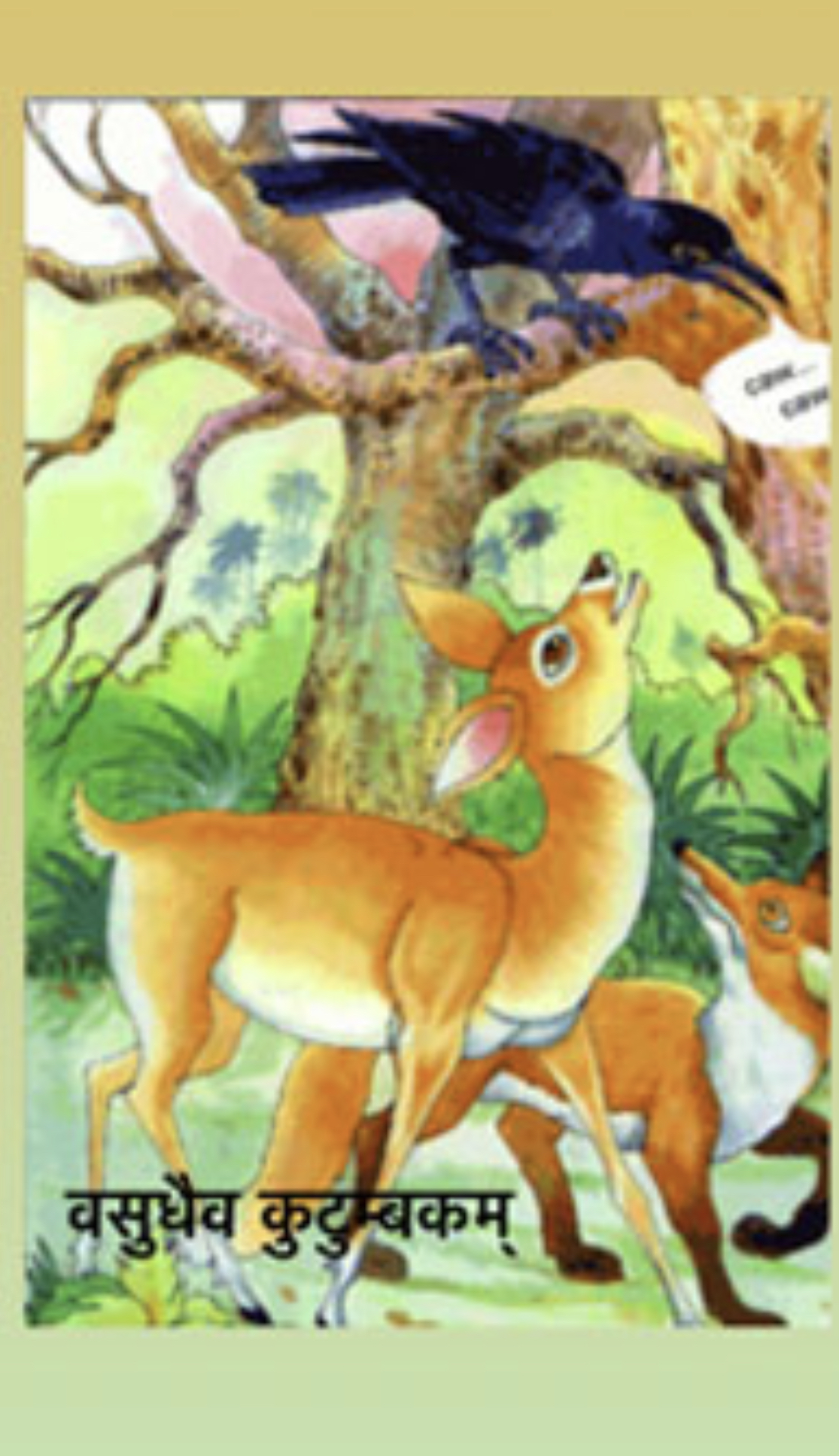
However, coming back to the present chant of vasudhaiva kutumbhakam, in the story the wily jackal quotes this very shloka to befriend the naive deer. 

To calm the trepidation of the deer and gain confidence the jackal keeps repeating that we can be friends, for after all we are all one family, that people who think otherwise are mean spirited. The motive being to lead the deer to the pack to be killed and devoured. 

The crow, a former friend of the deer keeps warning the deer who foolishly follows the jackal in a euphoric state of bonhomie. In the childhood recital of the story the deer escapes through the intervention of the crow. 

The lesson of this story was to beware the princes of foes befriending them by quoting and professing a philosophy of inclusiveness with an ulterior motive of defeating them.

India and Earth family

Leading from there I thought of India in present day scenario, struggling to upkeep her image of a secular country and society. Battered by narratives of pseudo liberals and a far left determined in its hatred of Hindu thought and philosophy, by majority and minority appeasement politics, struggling still to free herself from the emotional burden of 700 years of Islamic rule and then over 400 years of the French and Portuguese in certain parts and the British in the rest of the country. 

A country that gave refuge to the persecuted Parsis, the family of Prophet Mohammed and the Tibetans to name a few, is today being called to prove her inclusiveness! I was moved to tears at this thought.

In this context the story of the jackal and deer needs to be more understood, I felt. 

When in the name of Vasudhaiva Kutumbhakam (secularism) forces with an agenda (the jackal) lead the good at heart and easily misled folks, who are majority of people, (deer) and the wise seers (crows), who keep warning and are either ignored and called names or are in fact labelled anti peace forces and conspiracy theorists, it is time to take note. 

I feel one reason for India’s being conquered time and again has been an adherence to this deep rooted mind set of Vasudhaiva Kutumbhakam and the dilemma it creates in the mind of its people.

This was the first extent of my process of thought how when the philosophy of a country and its majority people is inclusiveness, has to deal with narratives that are fashioned to prove otherwise by forces whom they have to be warned of and somehow exclude from this earth as all-embracing family philosophy.

A very difficult task indeed and which could cause a mental psychotic breakdown in the sensitive or make them put their head in the sand and refuse to engage or keep on embracing the fox as they are torn apart.

As I practice and teach Yog Sadhana and heart centre expansion, unconditional love is a by-product of the yog sadhana as the human transforms into the divine.

It is a moot point to understand how to amalgamate the qualities of a warrior with a lover without losing either.

But I am emboldened when I think of our texts like the Bhagavad Gita which extol to fight to protect the weak, to uphold dharma, of personages like Adi Shankaracharya who came at a time when the Buddhist outlook, it was felt was robbing the Bharatiya mind-set of its warrior like qualities. May be foresaw the future, I wonder! 

The invasions and the long stint of being ruled by foreigners subjected Indians to genocide and systemic conversions and economic loot, to famines, taxes and subjugation of our culture? Our Sikh Gurus started preparing well in time for the great fight, gurus like Swami Samarth Ram Das took heed and started training soldiers and warriors for the war. 

There was no dichotomy in being a spiritual practitioner, warrior and saviour.

As a result of which India is one of the only country to have survived with its indigenous culture and ancient customs still alive and thriving, visible from the shlok, the subject of this blog. The rest of the world crumbled under Islam and Christian conquests. 

Deer and Jackal in the Marketplace

Then cruising along this thought stream my mind came to the field of the market of ideologies, spirituality and religion. 

The simple seekers (deer) who are led on a merry dance by charlatan saints, priests, gurus, granthis and maulvis, by mentors and influencers (jackal), do include any others I may have forgotten here! Promising the followers everything from a state of eternal bliss, to virgins in heaven, to a promised land, an egalitarian society. In their greed for name and fame they quote vasudhaiva kutumbhakam or its equivalent! The seer who warns the seekers of the ulterior motives of such charlatans is often shamed and brought down. (That does not mean everyone who is brought down is a seer!)

As a deer today, the danger may not be about being killed but you may be recruited, inducted, radicalised or indoctrinated into the ideology or religious belief system of the jackal, whoever it might be, left or right. Without being aware you become a means for attracting more deer to be slaughtered or recruited.

The corporate world is not free from this phenomenon either; the world seemed to me to be divided today, into deers and jackals with very few seers, people with the ability to see with clarity.

In our personal inner spheres too the senses, and the mind (deer), led outwards by sensual and material attractions (jackal) and our vivek buddhi – the discerning intellect seer (crow) can keep warning us in vain.

At a time like this how can one be sure one is the deer and not the jackal?

When the deer sees without doubt, the jackal for what IT is, the deer becomes the seer. 

For me, this clarity of perception only comes as our biases and conditioning is cleared. This can be achieved in many ways, the path of Yog Sadhana being one of them. It is the heightening of our intuitive perception that cuts through the obvious and the apparent and can get to the core motive of the other, and yes of oneself. 

Constantly introspecting to see if one is a deer being influenced by a jackal or a jackal recruiting other deers. A seer is a person who is neither but has the wisdom to be aware of both.

The seer, in my realisation, is always rooted firmly in the soil of vasudhaiva kutumbhakam, seeing the earth as one family and embracing all. And though the seer, warns about the fox, can see clearly the motive and agenda and can take any action to deter the jackal from devouring the deer, emotionally, physically and mentally, there is no hate for nor fear of the jackal in the action.

Until this final realisation comes, one swings like a pendulum or seesaw between deer and the seer unless one is the jackal, in which case we are part of a larger pack and may require an immense effort to self-extricate and get away or paying heed to a seer may help us do that. 

In conclusion, for me, applied introspection in every situation is the way to identify our roles as deer, jackal or seer.