Live free yoga

Liberated living through the sadhana of yog; enlivened realisations by the grace of the Guru.


Leave a comment

Gurudakshina a ऋण भङ्गुर – breaking of debt.

Having written so much about the Guru-Shishya Parampara, it was but natural that I arrived at this topic by and by. I have touched upon this topic in my book One Master one disciple – peeling of an onion, but new realisations and gnosis dawn upon any serious practitioner as the neuron in the brain light up during meditation as it did for me. This phrase ऋण भङ्गुर came to me while in meditation and was an ah ha moment as new light shone upon an old subject.

This is a short post on a much maligned and over explained tradition of gurudakshina, an offering expected of a shishya when receiving diksha into a particular sadhana from a teacher. The incident that always comes to my mind when a gurudakshina is mentioned is the example of Ekalavya and Dronacharya. The morality of the incident, the motives behind the demand by Dronacharya, can and have been endlessly debated and is not the purview of this post. I mention this here to lay out the ancient act of repaying the Guru for teachings imparted. An act that continues to exist till today, interpreted in various ways to suit various needs.

As always the topic in my posts are drawn from my own inner churning and meant to provoke thought, they are not meant for debate or arguments. On the spiritual path one has one’s own realisations and they hold true for one and that’s how it should be. Each person responsible or their own actions arising from their realisation.


Gurudakshina in the 21st Century

In today’s context, teachers and gurus, mostly of yoga and spiritual techniques have bent over backwards to explain this tradition of gurudakshina. Many do this to gloss over the excessive and exorbitant fee charged by them. The idea seems to be the higher your fee the more your stature as a guru, for you see you can never repay the guru for the teachings imparted so it doesn’t matter how much you pay, it’s never enough.

Added to the fee may be the material desires of the teacher, to own an expensive car, a house, land, travel and so on passed on to the student in the fee. So the fee charged is not just for the teaching but includes baser needs of the teacher that have to be satisfied. Yog that was meant as a sacred learning to be imparted in an atmosphere of sanctity, sans greed, has today become means of livelihood for many and with that has come the dichotomy of fitting this sacred practice into a mercenary mould.

The plethora of spiritual teachers today have given rise to a plethora of explanations about this topic, some genuine, some mere excuses, many a repetitive litany.

A paradox like no other

After having said all this about the current pattern of charging of fee by teachers of new age spirituality, I will be amiss if I don’t mention a contrary point.

It stands to reason that if the end goal of self-realisation is achieved by the disciple by diligently adhering to the principles laid out by their guru; they can never repay the guru for this service. My own sentiments for my Guru is surely impacted by this understanding. No matter the human qualities of the guru, your progress on the path will determine your obligation to the Guru. This assessment by nature is very personal and self imposed, it cannot be determined by another. Yes, it’s a paradox and involves what is called the vivek buddhi inherent in every learner, it may be dormant but will emerge with sadhana, sometimes of many lives.

Personal Turmoil

As a teacher for over 26 years, first within an organisation and now on an individual capacity I had struggled much with the morality of the asking in this offering. A fixed fee that kept rising steeply over the years, often beyond the reach of ordinary folks. The question that greatly bothered me was, is the practice only for the affluent? What about the sincere seekers with paltry means? I had in my own level always accommodated everyone who was sincerely seeking to learn. From the beginning I had always felt the dakshina was more in the purview of the taught rather than the teacher. It’s the student who decides what the lessons are worth to them, rather than the teacher putting a value on their wisdom, for true wisdom flows for all without bias.

But so greatly ingrained is the topic that it took a while to break free of it and the penultimate realisation came with the two words ऋण भङ्गुर II

ऋण भङ्गुर – a liberation

They were two simple words but they illumined my being with, for me, the understanding of this ancient practice. The realisation that the dakshina liberates both the guru and the shishya from obligation to one another in the grosser level. Once this gross cord is cut all that remains is the cord of love that binds the Guru and the shishya in an eternal dance towards the ultimate liberation, when the guru liberates the shishya even from this fixed orbit to chart their own course free of the gurus influence.

Now when I share the practice with new seekers I allow them to decide the dakshina they want to give. With no attachment to the amount given, I am twice liberated.


2 Comments

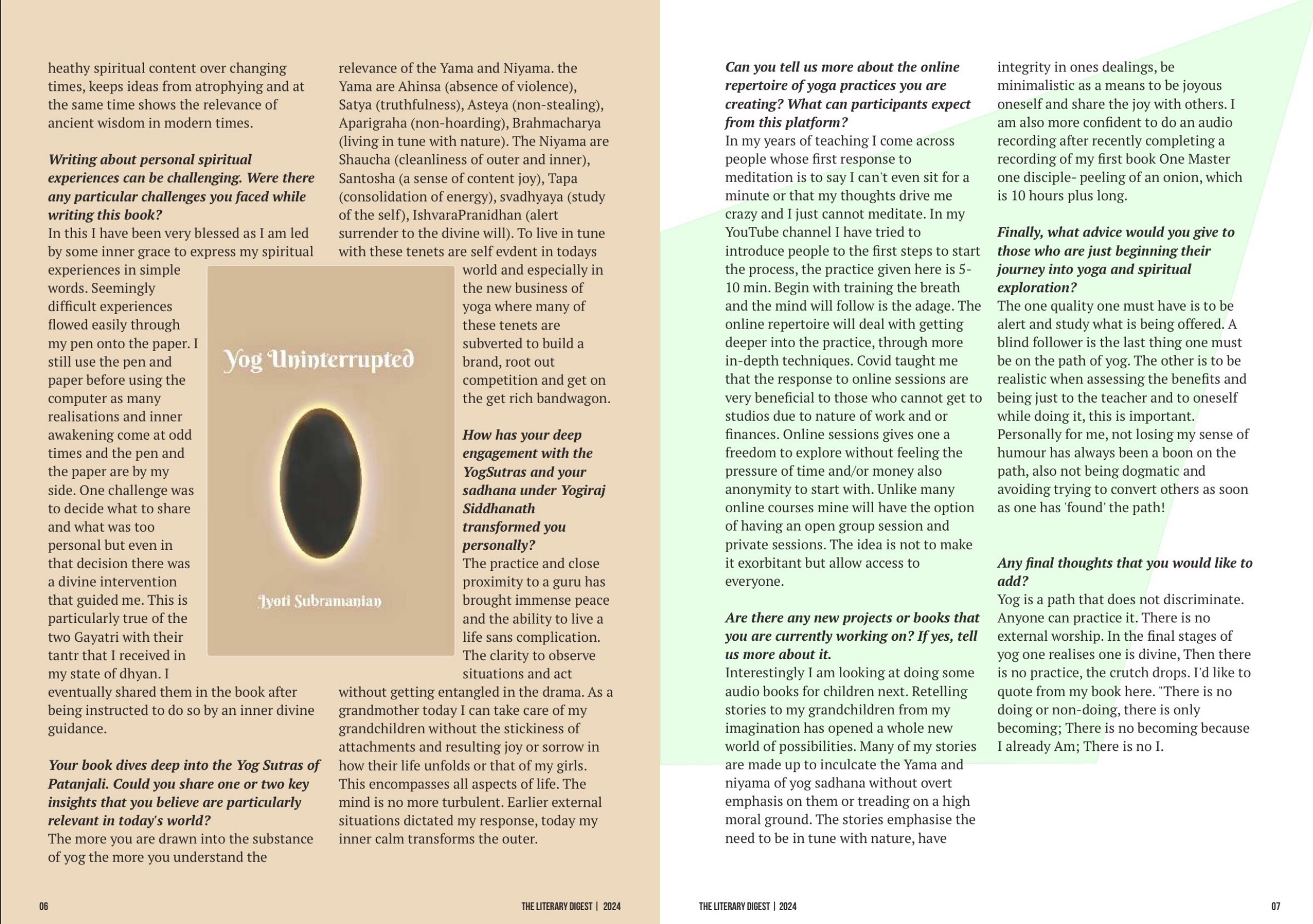
Interview in The Literary Digest – March 2024


Author Interview JYOTI SUBRAMANIAN

Can you walk us through your personal and professional journey while highlighting how yoga impacted the same?
As most people of my generation born in the 50’s and 60″s I was introduced to yoga first
at home by my parents and then formally at school. Yog then became a way of life even if I was not consciously aware of it at that time. Taking refuge in the practice of Asans and Pranayam during stressful periods in life became natural. As a mother of 2, an entrepreneur running my own housekeeping business and helping with the larger family farm, there were many such moments and the childhood inculcation into the practice of yoga came very handy to manoeuvre my way through difficulties. Introduction to Kriya Yoga occurred in my mid thirties as a result, I feel, of the conscientious adherence to yoga since childhood. It prepared the soil so to speak for the seeds of higher sadhana when dropping all other activities I got wholly into the sharing of Kriya Yoga with others as instructed by my Guru and have been doing so for the past 25 years.


What inspired you to write “Yog Uninterrupted” and how do you hope it
will impact its readers?

Yog Uninterrupted started as a collection of my writings, blogs and articles scattered in various newspapers into one book, as a request from my students. But as I started writing an overwhelming tsunami of information and realisations of over 55 years on this path made their way into the book making it a work of my lifetime understanding of this very personal and individual journey. The intention of the book is not to preach but to provoke thought so the reader and practitioner of yog can apply their own realisations to this study. We are so fortunate to have so many stalwarts of not just yoga but many other paths leaving behind their philosophical musings, I strongly feel it is very important to pen down ones own journey for others who may want to study, debate, disagree or agree with our philosophy. This inculcates a heathy spiritual content over changing times, keeps ideas from atrophying and at the same time shows the relevance of ancient wisdom in modern times.


Writing about personal spiritual experiences can be challenging. Were there any particular challenges you faced while writing this book?
In this I have been very blessed as I am led by some inner grace to express my spiritual experiences in simple words. Seemingly difficult experiences flowed easily through my pen onto the paper. I still use the pen and paper before using the computer as many realisations and inner awakening come at odd
times and the pen and the paper are by my side. One challenge was to decide what to share and what was too personal but even in that decision there was a divine intervention that guided me. This is particularly true of the two Gayatri with their tantr that I received in my state of dhyan. I eventually shared them in the book after being instructed to do so by an inner divine guidance.

Your book dives deep into the Yog Sutras of Patanjali. Could you share one or two key insights that you believe are particularly relevant in today’s world?
The more you are drawn into the substance of yog the more you understand the relevance of the Yama and Niyama. the Yama are Ahinsa (absence of violence), Satya (truthfulness), Asteya (non-stealing), Aparigraha (non-hoarding), Brahmacharya (living in tune with nature). The Niyama are Shaucha (cleanliness of outer and inner), Santosha (a sense of content joy), Tapa (consolidation of energy), svadhyaya (study of the self), IshvaraPranidhan (alert surrender to the divine will). To live in tune with these tenets are self evident in todays world and especially in the new business of yoga where many of these tenets are subverted to build a brand, root out competition and get on the get rich bandwagon.


How has your deep engagement with the YogSutras and your sadhana under Yogiraj Siddhanath transformed you personally?
The practice and close proximity to a guru has brought immense peace and the ability to live a life sans complication. The clarity to observe situations and act without getting entangled in the drama. As a
grandmother today I can take care of my grandchildren without the stickiness of attachments and resulting joy or sorrow in how their life unfolds or that of my girls. This encompasses all aspects of life. The mind is no more turbulent. Earlier external
situations dictated my response, today my inner calm transforms the outer.

Can you tell us more about the online repertoire of yoga practices you are creating? What can participants expect from this platform?
In my years of teaching I come across people whose first response to meditation is to say I can’t even sit for a minute or that my thoughts drive me crazy and I just cannot meditate. In my YouTube channel I have tried to introduce people to the first steps to start the process, the practice given here is 5-10 min. Begin with training the breath and the mind will follow is the adage. The online repertoire will deal with getting deeper into the practice, through more in-depth techniques. Covid taught me that the response to online sessions are very beneficial to those who cannot get to studios due to nature of work and or finances. Online sessions gives one a freedom to explore without feeling the pressure of time and/or money also anonymity to start with. Unlike many online courses mine will have the option of having an open group session and private sessions. The idea is not to make it exorbitant but allow access to everyone.

Are there any new projects or books that you are currently working on? If yes, tell us more about it.
Interestingly I am looking at doing some audio books for children next. Retelling stories to my grandchildren from my imagination has opened a whole new world of possibilities. Many of my stories are made up to inculcate the yama and niyama of yog sadhana without overt emphasis on them or treading on a high moral ground. The stories emphasise the need to be in tune with nature, have integrity in ones dealings, be minimalistic as a means to be joyous oneself and share the joy with others. I am also more confident to do an audio recording after recently completing a recording of my first book One Master one disciple- peeling of an onion, which is 10 hours plus long.

Finally, what advice would you give to those who are just beginning their journey into yoga and spiritual exploration?
The one quality one must have is to be alert and study what is being offered. A blind follower is the last thing one must be on the path of yog. The other is to be realistic when assessing the benefits and being just to the teacher and to oneself while doing it, this is important. Personally for me, not losing my sense of humour has always been a boon on the path, also not being dogmatic and avoiding trying to convert others as soon as one has ‘found’ the path!

Any final thoughts that you would like to add?
Yog is a path that does not discriminate. Anyone can practice it. There is no external worship. In the final stages of yog one realises one is divine. Then there is no practice, the crutch drops. I’d like to quote from my book here,
“There is no doing or non-doing, there is only becoming;
There is no becoming because I already Am; There is no I.”


Yog Uninterrupted Kindle and Hardcover
One Master one disciple- peeling of an onion Kindle and Paperback
Audiobook One Master one disciple -peeling of an onion

Ayulife YouTube Channel


1 Comment

of Alignment and Misalignment on Lunar Eclipse


Last night was full moon and lunar eclipse, it was also Kartik Purnima, Dev Deepavali and Gurpurab. Yes, a pretty auspicious time for many. Yogis to purohits to devotees all use this period to meditate, worship, shower adulations or pray, each according to their own understanding and devotion, as do the lovers of astronomy. I was fortunate to be in Tubac, Arizona for yesterdays event experience, with clear cloudless skies, no light pollution and an unhindered open horizon. As the shadow of the earth progressed over the bright full moon and cloaked the earth with darkness, the stars shined ever so much more brilliantly until the moon now totally eclipsed, turned crimson. Much to be grateful about.

First the alignment

As a yog practitioner, I have for many decades now viewed an eclipse as an alignment of the earth, the moon and the sun according a unique opportunity to align those centres in our own body that correspond to them. The Vedic pind-brahmand philosophy lays much emphasis on the microcosm carrying in entirety the blueprint of the macrocosm and while some revere the external others turn their awareness inwards at such moments using the event to take a leap to understand the universe within.

Before I go further there’s something I need to make clear.  I always write propelled by my own experience and realisations strongly believing that no sadhak should take as absolute others realisations. The layers of the mystical are profound and the joy of self discovery can never be understated. Texts and philosophical literature are someone else’s Truth and have only an intellectual value for me and easy to disregard if they don’t pass my self scrutiny. We each one of us have to find our own truth without a need for validation, I sincerely believe. To move on on this path of self discovery with confidence towards what makes us truly happy all we need is a will to do so and the tools to take us forward appear magically. Of course all results are greatly influenced by the fruits of our past karma and present personal efforts.

Here I will note down some musings on these physical eclipse occurrence and how I understand it to affect our body, emotions and mind. These applied realisations have greatly enabled me to bring balance in my life. I have also included a link to a meditation I recorded after this event at the end of this section.

As mentioned earlier during an eclipse, whether full or partial, there is a corresponding full or partial alignment of the sun, the earth and the moon and this reflects in our body in different ways, I have found. Our left and the right naadis in yogic terms the Ida and Pingala correspond to the Chandra (moon) and Surya (sun), connecting to the two polarities in our brain- the right and left hemispheres. The earth corresponds to our mool prakriti, the innate nature of our body, While consciously aligning these spheres during the eclipse we enable ourselves to flow with the circadian rhythm of the universe reducing conflict in our emotional and mental body- the manomaya kosha. Living without conflict with nature ones nature becomes that of stillness and the physical body receives the benefit of health of such peaceful living without stress.

Another realisation I experienced is that of the moon, the sun and the earth aligned along the spine. The moon in the Agnya Chakra indicating the mind, the Sun in the Anhad Chakra as distributor of Pran and the earth on the muladhar representing everything physical, earth, water, fire air and the space occupied when alive, in death all these return to the source.

Finally, as the moon corresponds to the mind, and it is well known how the lunar cycle effects our mind, when the shadow of the earth passes over the moon enveloping it fully and then the moon reemerges as the shadow passes, it as if a veil is removed, a veil of ignorance and the mind full of awe rebirths into a clarity facing the brilliant sun. This outer light is reflected in the inner transformation of the yogi practitioner.

click this 👉🏽 Practicing Alignment on Eclipse Days


Misalignment Galore

-my God/Guru is greater than yours

Of course after this wonderful alignment with nature and the sun and the moon and the earth, I had to open my phone! Being a festive day, I had received many forwards, wishes for Kartik Purnima, for Dev Deepavali, and Gurpurab, usually I delete them all without seeing but I had to open this one didn’t I 🤷🏻‍♀️, a forward for Gurpurab. Gurpurab is the birth centenary of Guru Nanak Devji, the first Sikh Guru. It was originally from a UK based Sikh organisation, forwarded many times WhatsApp informed me and now forwarded to me by a well meaning friend and it caught my attention. It had a picture of Nanak’s father holding baby Nanak in his arms, and in front of them stood bowing in supplication, many divine beings, of whom I recognised Brahma because of the multiple heads, Vishnu because of the blue body, and Shiva because of the snake around the neck and many other Devi’s and Devata’s, all from the Hindu diaspora. It wasn’t a very well executed picture but it started a flow of thought as to why to make our own Guru or God greater we have to show others down as inferior to them?

Sometimes these representations are malicious, but often it is just the devotion of the devotee to showcase their own as somehow better, greater and grander. Everyone has done this in history and still continue to do so, Vaishnavites show Vishnu as superior to Shiva, followers of Gorakhnath show Krishna washing Gorakhs feet, the worshippers of Shakti show her as more than Shiva, saying Shiva is Shav without Shakti, amongst disciples there is always a rush to prove their own gurus as the true one. This is just within the boundary of one religion, my father once told me how when they were kids in the late 1930’s, Christian missionaries would come to their small village in Kerala and demonstrate how an idol of Krishna sinks when thrown into the well but the idol of Jesus Christ floats. The idol of Krishna was made of metal and Jesus of wood! All the children watching could see that and found it quite foolish. Wonder how many tenets of the religion is broken whith these actions? I am mostly amused by this show, but it is a point to be noted and care taken not to fall into this trap ourselves in the rush to preach and share.

I feel this maybe one of the reason that I found myself pulled towards yog sadhana, where all these concepts can be on a different level of understanding. The body becomes the temple, and all the deities are accommodated within, Shiva and Shakti, Brahma and Vishnu, Ganesh and Hanuman; The Ganga, Yamuna and Saraswati, all equally important or not, their roles dictated by the state the practicing yogi is in. A journey of Self-discovery untainted by the external show. All the forms reveal an inner symphony without any discordant note, to the one who is sensitive.

Removing the veil

Finally, for the yogi, these deities if present, losing their physical attributes amalgamate into Still Love, as they did for me. A core centre of stillness that only translates as Love, shorn of all rites and rituals internal or external. The inner and the outer Guru can stand alone, without support of validation, comparison and or competition.


Leave a comment

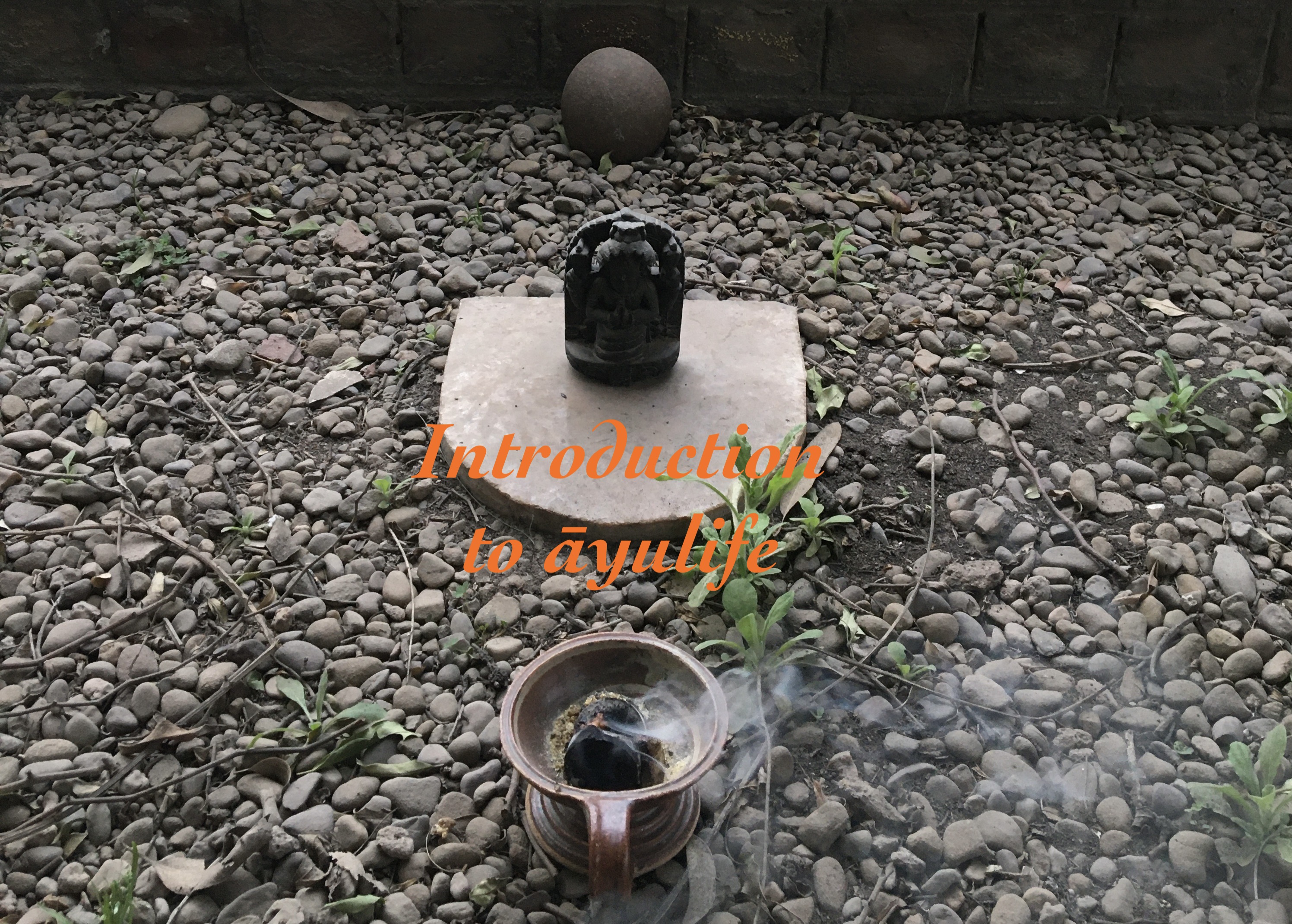
āyulife channel- a nascent step

After a few months of hiatus, I recently started a process very close to my heart, sharing some simple yogic practices arising out of my sadhana on an open platform. Along with the written word on my blogs and book, I have now included the spoken via my YouTube channel- ayulife.


www.youtube.com/ayulife

Yog is a very private and personal journey, in my understanding. Even though thousands may receive the same set of practice, may practice the same Asans, Pranayam and methods of Dharana, it flowers in each of us uniquely because we are each unique and one of a kind. Even though the final result may be the same of Self-Realisation, the path will vary dictated by our individual nature and set of karma.

ayulife is a sincere and joyful attempt at expressing my deep felt and realised understanding of yog, which is one of the six systems- the shad-darshana of Vedic Sanatan way of realisations. System is a very limiting way of describing what is really ‘seeing’ with an inner eye, in-depth and without filters.
The six are each in themselves a vast insight into the philosophy on which is based the present day Hindu “religion’ itself a limiting term for this ocean of enlightened text. I am just giving a brief by line here which according to me is a very inadequate explanation of such profound subjects, but just a taste of the brilliance of the Indic intellect and its range and what it has offered to those like us on the path to savour and explore and discard. All 6, with many sections and sub sections overlap each other and influence the practitioners of one or the other.
.
The shad- darshanas and their originator.
1. Nyaya Darshana- the path of logic and reasoning, removing of ignorance brings an end to suffering, right knowledge brings liberation to the human soul. Rishi Gautama
2. Vaisheshika Darshana- metaphysics, the study of atom (anu), of materials from gross to subtle, of their similarities and differences, of those that exist and the lack of existence, the eternal and non-eternal and Karma- action and reaction, creation and dissolution, to name a few. Rishi Kannada Kashyapa
3. Yog Darshana- the path of uniting the individual spirit to the universal spirit via the 8 limbs of yam, niyam, asan, pranayam, pratyahar, dharana, dhayn and samadhi. Rishi Patanjali
4. Samkhya Darshana- a non-theistic path of dualism, there’s no room for Isvara or God here. The study of Purusha and Prakriti- the moving and unmoving principles, of evolution from material and external pleasures to pure consciousness. Rishi Kapila and IsvaraKrishna
5. Purva-Mimamsa Darshana (Karma Kanda)- Establishes the authority of the Vedas, the magical power of mantras and yagnyas, potency of rituals, the existence of a soul, duties and obligations, embodying the philosophy of Karma Yoga and requirement to move through the 4 varna ashram of brahmacharya, grihasta, vanaprastha and Sanyasa. Rishi Jamini
6. Vedanta Darshana ( Uttara Mimamsa)- Focussing on the Upanishads, emphasising the importance of a Guru, rather than the ritualistic components. Vedanta actually means the end or the conclusion of the vedas. It’s like a synopsis of the 4 vedas Rig, Yajur, Sama and Athrva, taking the nectar from these. It includes the concept of dvait (dualism), advaita (non dualism). Rishi Badarayana

One must remember that the Indic Sanatan philosophy has a strong base of accepting and refuting deep rooted systems and this right is extended to every student of these systems.

I was introduced to these concepts as a child just by being born into a family in which these topics were the norm at home. Discussions and debates amongst my elders revolved around these topics. At a very early age I had started discarding many of these “truths” and was clearly gravitating to the path of Yog, which I find very liberating in its simplicity. I met my Guru Yogiraj Siddhanath from the lineage of Kriya Yoga of Mahavatar Babaji in 1998, first in a vision and then in person. I was under his tutelage and taught the evolutionary practice of Kriya Yoga for 23 years. I have recollection of my years with Lahiri Mahasaya, when I was first initiated into this practice. I am sharing this here because education continues from lifetime to lifetime and expresses and fructifies in this life as per the efforts put in lives past.

You will find many of the concepts from the other darshanas that have influenced me not by reading but directly through realisations, in my writing as well as on my channel.

In ayulife it will be my sincere effort to share those techniques that have helped me over the decades to come to a state of clarity, equilibrium and equipoise and hope it helps others too. The nature of the open platform being such, I am bound to exercise some discretion on the content, for more advanced practice I will be launching an online platform soon. Once again I share the link here. Do subscribe and I thank you all in advance for your support.

www.YouTube.com/ayulife