Live free yoga

Liberated living through the sadhana of yog; enlivened realisations by the grace of the Guru.


Leave a comment

Gurudakshina a ऋण भङ्गुर – breaking of debt.

Having written so much about the Guru-Shishya Parampara, it was but natural that I arrived at this topic by and by. I have touched upon this topic in my book One Master one disciple – peeling of an onion, but new realisations and gnosis dawn upon any serious practitioner as the neuron in the brain light up during meditation as it did for me. This phrase ऋण भङ्गुर came to me while in meditation and was an ah ha moment as new light shone upon an old subject.

This is a short post on a much maligned and over explained tradition of gurudakshina, an offering expected of a shishya when receiving diksha into a particular sadhana from a teacher. The incident that always comes to my mind when a gurudakshina is mentioned is the example of Ekalavya and Dronacharya. The morality of the incident, the motives behind the demand by Dronacharya, can and have been endlessly debated and is not the purview of this post. I mention this here to lay out the ancient act of repaying the Guru for teachings imparted. An act that continues to exist till today, interpreted in various ways to suit various needs.

As always the topic in my posts are drawn from my own inner churning and meant to provoke thought, they are not meant for debate or arguments. On the spiritual path one has one’s own realisations and they hold true for one and that’s how it should be. Each person responsible or their own actions arising from their realisation.


Gurudakshina in the 21st Century

In today’s context, teachers and gurus, mostly of yoga and spiritual techniques have bent over backwards to explain this tradition of gurudakshina. Many do this to gloss over the excessive and exorbitant fee charged by them. The idea seems to be the higher your fee the more your stature as a guru, for you see you can never repay the guru for the teachings imparted so it doesn’t matter how much you pay, it’s never enough.

Added to the fee may be the material desires of the teacher, to own an expensive car, a house, land, travel and so on passed on to the student in the fee. So the fee charged is not just for the teaching but includes baser needs of the teacher that have to be satisfied. Yog that was meant as a sacred learning to be imparted in an atmosphere of sanctity, sans greed, has today become means of livelihood for many and with that has come the dichotomy of fitting this sacred practice into a mercenary mould.

The plethora of spiritual teachers today have given rise to a plethora of explanations about this topic, some genuine, some mere excuses, many a repetitive litany.

A paradox like no other

After having said all this about the current pattern of charging of fee by teachers of new age spirituality, I will be amiss if I don’t mention a contrary point.

It stands to reason that if the end goal of self-realisation is achieved by the disciple by diligently adhering to the principles laid out by their guru; they can never repay the guru for this service. My own sentiments for my Guru is surely impacted by this understanding. No matter the human qualities of the guru, your progress on the path will determine your obligation to the Guru. This assessment by nature is very personal and self imposed, it cannot be determined by another. Yes, it’s a paradox and involves what is called the vivek buddhi inherent in every learner, it may be dormant but will emerge with sadhana, sometimes of many lives.

Personal Turmoil

As a teacher for over 26 years, first within an organisation and now on an individual capacity I had struggled much with the morality of the asking in this offering. A fixed fee that kept rising steeply over the years, often beyond the reach of ordinary folks. The question that greatly bothered me was, is the practice only for the affluent? What about the sincere seekers with paltry means? I had in my own level always accommodated everyone who was sincerely seeking to learn. From the beginning I had always felt the dakshina was more in the purview of the taught rather than the teacher. It’s the student who decides what the lessons are worth to them, rather than the teacher putting a value on their wisdom, for true wisdom flows for all without bias.

But so greatly ingrained is the topic that it took a while to break free of it and the penultimate realisation came with the two words ऋण भङ्गुर II

ऋण भङ्गुर – a liberation

They were two simple words but they illumined my being with, for me, the understanding of this ancient practice. The realisation that the dakshina liberates both the guru and the shishya from obligation to one another in the grosser level. Once this gross cord is cut all that remains is the cord of love that binds the Guru and the shishya in an eternal dance towards the ultimate liberation, when the guru liberates the shishya even from this fixed orbit to chart their own course free of the gurus influence.

Now when I share the practice with new seekers I allow them to decide the dakshina they want to give. With no attachment to the amount given, I am twice liberated.


2 Comments

Interview in The Literary Digest – March 2024


Author Interview JYOTI SUBRAMANIAN

Can you walk us through your personal and professional journey while highlighting how yoga impacted the same?
As most people of my generation born in the 50’s and 60″s I was introduced to yoga first
at home by my parents and then formally at school. Yog then became a way of life even if I was not consciously aware of it at that time. Taking refuge in the practice of Asans and Pranayam during stressful periods in life became natural. As a mother of 2, an entrepreneur running my own housekeeping business and helping with the larger family farm, there were many such moments and the childhood inculcation into the practice of yoga came very handy to manoeuvre my way through difficulties. Introduction to Kriya Yoga occurred in my mid thirties as a result, I feel, of the conscientious adherence to yoga since childhood. It prepared the soil so to speak for the seeds of higher sadhana when dropping all other activities I got wholly into the sharing of Kriya Yoga with others as instructed by my Guru and have been doing so for the past 25 years.


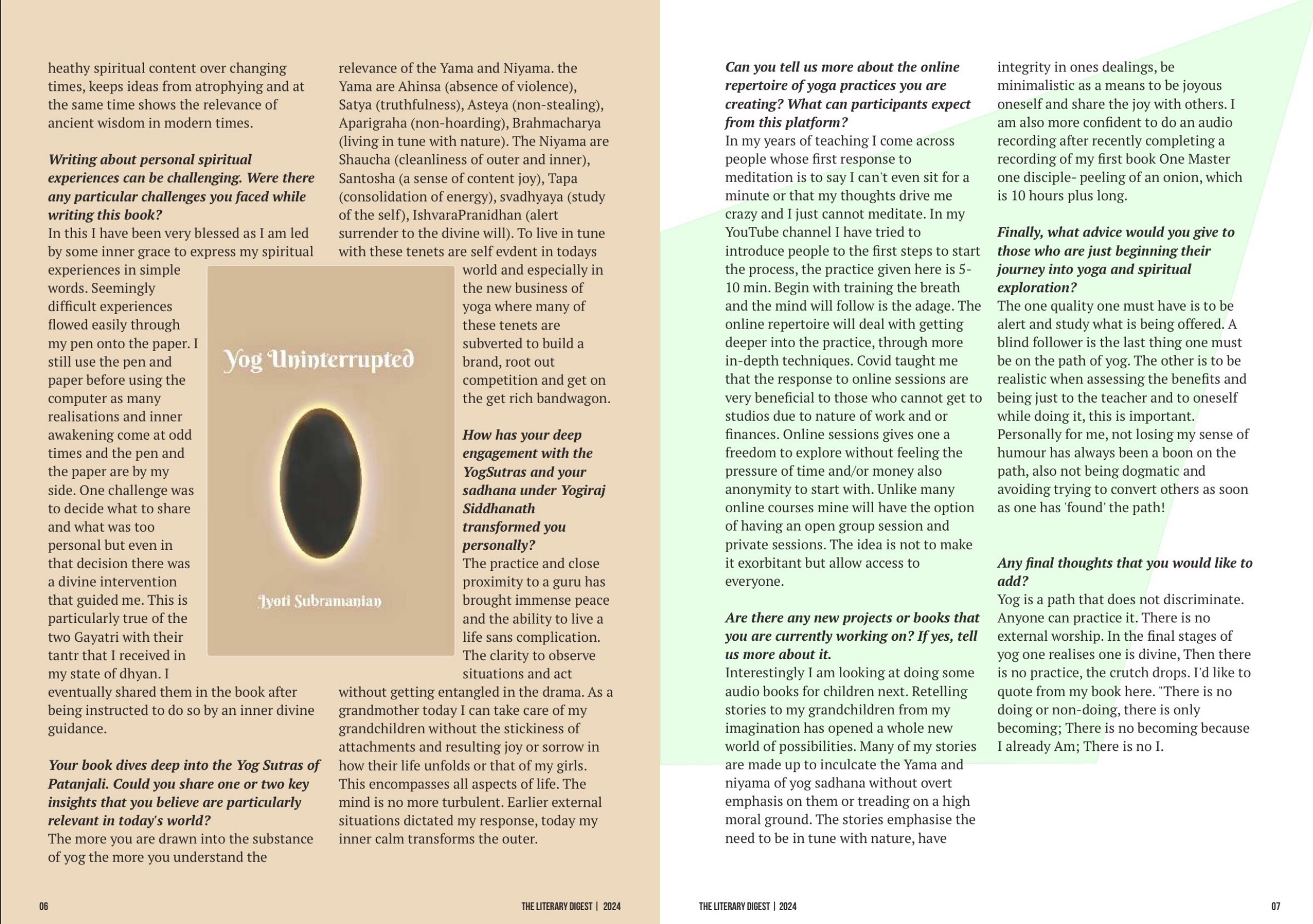
What inspired you to write “Yog Uninterrupted” and how do you hope it
will impact its readers?

Yog Uninterrupted started as a collection of my writings, blogs and articles scattered in various newspapers into one book, as a request from my students. But as I started writing an overwhelming tsunami of information and realisations of over 55 years on this path made their way into the book making it a work of my lifetime understanding of this very personal and individual journey. The intention of the book is not to preach but to provoke thought so the reader and practitioner of yog can apply their own realisations to this study. We are so fortunate to have so many stalwarts of not just yoga but many other paths leaving behind their philosophical musings, I strongly feel it is very important to pen down ones own journey for others who may want to study, debate, disagree or agree with our philosophy. This inculcates a heathy spiritual content over changing times, keeps ideas from atrophying and at the same time shows the relevance of ancient wisdom in modern times.


Writing about personal spiritual experiences can be challenging. Were there any particular challenges you faced while writing this book?
In this I have been very blessed as I am led by some inner grace to express my spiritual experiences in simple words. Seemingly difficult experiences flowed easily through my pen onto the paper. I still use the pen and paper before using the computer as many realisations and inner awakening come at odd
times and the pen and the paper are by my side. One challenge was to decide what to share and what was too personal but even in that decision there was a divine intervention that guided me. This is particularly true of the two Gayatri with their tantr that I received in my state of dhyan. I eventually shared them in the book after being instructed to do so by an inner divine guidance.

Your book dives deep into the Yog Sutras of Patanjali. Could you share one or two key insights that you believe are particularly relevant in today’s world?
The more you are drawn into the substance of yog the more you understand the relevance of the Yama and Niyama. the Yama are Ahinsa (absence of violence), Satya (truthfulness), Asteya (non-stealing), Aparigraha (non-hoarding), Brahmacharya (living in tune with nature). The Niyama are Shaucha (cleanliness of outer and inner), Santosha (a sense of content joy), Tapa (consolidation of energy), svadhyaya (study of the self), IshvaraPranidhan (alert surrender to the divine will). To live in tune with these tenets are self evident in todays world and especially in the new business of yoga where many of these tenets are subverted to build a brand, root out competition and get on the get rich bandwagon.


How has your deep engagement with the YogSutras and your sadhana under Yogiraj Siddhanath transformed you personally?
The practice and close proximity to a guru has brought immense peace and the ability to live a life sans complication. The clarity to observe situations and act without getting entangled in the drama. As a
grandmother today I can take care of my grandchildren without the stickiness of attachments and resulting joy or sorrow in how their life unfolds or that of my girls. This encompasses all aspects of life. The mind is no more turbulent. Earlier external
situations dictated my response, today my inner calm transforms the outer.

Can you tell us more about the online repertoire of yoga practices you are creating? What can participants expect from this platform?
In my years of teaching I come across people whose first response to meditation is to say I can’t even sit for a minute or that my thoughts drive me crazy and I just cannot meditate. In my YouTube channel I have tried to introduce people to the first steps to start the process, the practice given here is 5-10 min. Begin with training the breath and the mind will follow is the adage. The online repertoire will deal with getting deeper into the practice, through more in-depth techniques. Covid taught me that the response to online sessions are very beneficial to those who cannot get to studios due to nature of work and or finances. Online sessions gives one a freedom to explore without feeling the pressure of time and/or money also anonymity to start with. Unlike many online courses mine will have the option of having an open group session and private sessions. The idea is not to make it exorbitant but allow access to everyone.

Are there any new projects or books that you are currently working on? If yes, tell us more about it.
Interestingly I am looking at doing some audio books for children next. Retelling stories to my grandchildren from my imagination has opened a whole new world of possibilities. Many of my stories are made up to inculcate the yama and niyama of yog sadhana without overt emphasis on them or treading on a high moral ground. The stories emphasise the need to be in tune with nature, have integrity in ones dealings, be minimalistic as a means to be joyous oneself and share the joy with others. I am also more confident to do an audio recording after recently completing a recording of my first book One Master one disciple- peeling of an onion, which is 10 hours plus long.

Finally, what advice would you give to those who are just beginning their journey into yoga and spiritual exploration?
The one quality one must have is to be alert and study what is being offered. A blind follower is the last thing one must be on the path of yog. The other is to be realistic when assessing the benefits and being just to the teacher and to oneself while doing it, this is important. Personally for me, not losing my sense of humour has always been a boon on the path, also not being dogmatic and avoiding trying to convert others as soon as one has ‘found’ the path!

Any final thoughts that you would like to add?
Yog is a path that does not discriminate. Anyone can practice it. There is no external worship. In the final stages of yog one realises one is divine. Then there is no practice, the crutch drops. I’d like to quote from my book here,
“There is no doing or non-doing, there is only becoming;
There is no becoming because I already Am; There is no I.”


Yog Uninterrupted Kindle and Hardcover
One Master one disciple- peeling of an onion Kindle and Paperback
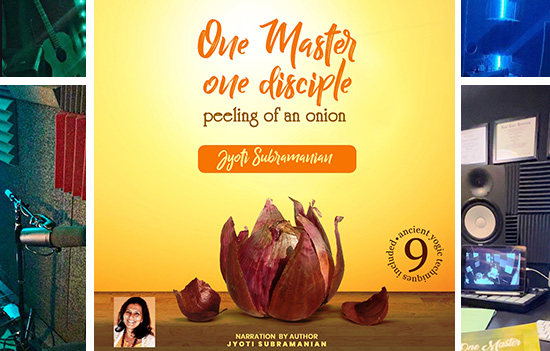
Audiobook One Master one disciple -peeling of an onion

Ayulife YouTube Channel


Leave a comment

TIPS for Recording an Audio Book 

First published in Esamskriti https://www.esamskriti.com/sa/Life/TIPS-for-Recording-an-Audio-Book–1.aspx

  • Kriyacharya Jyoti shares experience of searching for a recording studio in Los Angeles and importantly, gives Tips for Recording an Audio book.  

Recently, I decided to convert my autobiography One Master one disciple- peeling of an onion, into an audio book. 

By nature preferring written books, I had not invested any time in listening to audio books. It was only recently, after having moved to the US, that I ‘saw’ how many people listen to audio books, while going for a walk, jog or driving. Long commute times and hectic lifestyles had made this a feasible way for people to indulge in their reading habits while getting about their daily chores. This started the germination of the seed to explore audio narration as a mode of literary expression.

Especially interesting is the fact that so far I had ignored this form of expression; having been brought up in an environment of oral recitation of the Ved and Upanishad, the Bhagavad Gita, renditions of Adi Shankaracharya and mantras and chants that had been passed on and kept alive for ages, I should have been more aware of the power of the spoken word. 

My psyche was not jogged to the spoken word inspite of accompanying my parents, as a child, to talks of Swami Chinmayananadaji and many Sundays spent in such recitations in my Baal Vihar classes not to miss all those hours on AIR (All India Radio) listening to Havamahal and more recently catching snippets of storytelling by Neelesh Mishra. 

First Steps

However, once the idea took hold, I started right in earnest to explore the ways and means to achieve this. As is my habit the first option was Do it Yourself; since for years I was engaged in start-up work for my guru, organising events, venturing into uncharted territories, cities and countries to spread awareness of my Guru and his work on Mahavatar Babaji’s Kriya Yoga. Thus, the thought of DIY came rather naturally to me. 

I started reading up on home recording studio setups. Tips to convert a clothes cupboard or wardrobe into a home audio recording studio or a portion of a garage were aplenty. All of them required investment into some tools- recording equipment, buffers to reduce echo, stop sounds from penetrating through the walls, water pipes and flushes. It didn’t help that my neighbour played his drums at all odd hours, along with the barking dogs and the gardeners with their gas powered tools in the neighbourhood, soundproofing seemed a distant dream.

Finally, I decided to take the professional route and engage a recording studio with a sound engineer. This was in the United States and most studios charged an hourly fee which increased if you also wanted a professional engineer to sit through your recordings, which I did.

ACX, the Amazon audible platform had strict specs for the quality of recordings and this was far beyond my expertise. Even though the web is full of sites that give expert help on the use of apps to get the desired outputs. The younger generation may take this as a challenge but I did not want the hassle. 


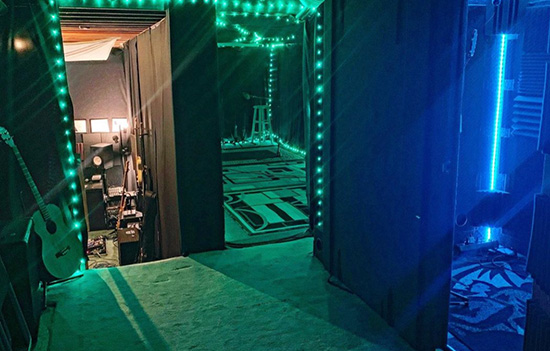
Space Mint Studio in Los Angeles. 

Finding a Studio

Next I started a tour of recording studios in the neighborhood. That was an adventure by itself. Some were seedy and not very clean whilst others smelled of weed from musicians who had used the studio the previous night. The majority of them however were quite professional and had dedicated spaces for small and large recording needs. Once I contacted them, most studios responded immediately and most were helpful with their inputs once they learnt I was new to this. 

Almost all of them suggested that I engage a professional narrator, someone who was familiar with this medium. But it was my story and I wanted to be the one narrating. I was not going to be daunted by the task ahead. 

Eventually, I was lucky to find a studio that was only a 15 minute commute. Evan Mykl, who owned the studio The Space Mint and was also the sound engineer, was very encouraging and helpful. The studio was in his residence and the energy was warm and welcoming. A one person show which was quite after my own heart. 


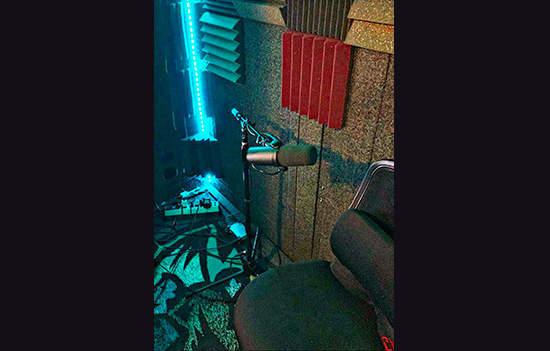
Place to sit and record. 

Learning about Narration Tips

Once I decided to do the narration myself, started a flurry of reading up on what to do for voice quality, dehydration, stomach rumbles and yes the biggest deterrent of them all Phlegm! 

How long I would be able to record each day was another point to ponder over since most studios required a minimum of two hours of booking. Read on.

Eventually I came upon a regimen that I am sharing with those who wish to walk this path. I started this a fortnight before I started recording.

1. Gave up all caffeinated drinks, coffee being my only one. 

2. Drank more water, room temp, with more awareness, gulping the poured water like we do in southern India, without sipping. It helped in keeping the epiglottis clear and throat muscles strong. 

3. Started a morning tea drink consisting of mulatthi (liquorice), chotti elaichi (cardamom), and adrak (ginger). 

4. Continued with Neti, followed by a practice of my personal dynamic pranayam. 

5Yogasan to boost upper chest and respiratory organs including neck, upper back and diaphragm. 

6. Yogic face exercises. 

7. I also practiced the svar अ आ इ ई etc and varnamala- क ख ग घ in an exaggerated manner. Intoning them loudly, often in the shower! 

8. Practiced my saptsvarmala as in music सा रे गा मा with other combinations 

9. I gave up all gluten and milk inclusive food- roti and parathas, dahi, milk, ghee, bread, pasta and pizzas. This was a miracle as the throat became completely clear in a few days of abstinence. I am continuing this even after the recording. 

10. I found that eating a besan ka chilla, with spinach and carrots, dhania and ginger before the recording kept my stomach rumbles in control. Some trial and errors moments did happen as fruit made my stomach rumble even though it is good for hydration, especially melons, apples and oranges. 

11. Also learnt that the more I chew my food the less the effort the stomach has to make!

It is amazing how sensitive the recording equipment is and how it catches any other sound including the breath. Consistent practice of pranayam for decades helped me with the breath work while reading. Also being a recent grandmother and reading aloud to my granddaughter for the past two years prepared me for this task, albeit unknowingly. 


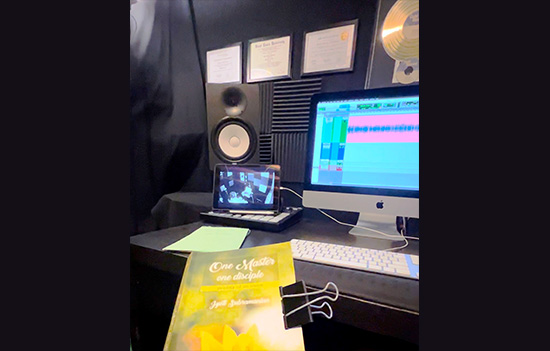
Recording in progress. 

All in all the recording went very well and after the first day I realised I could go on recording for two hours straight without a pause. The complete book of 300 pages took me 18 hours of recording over 10 days. Now it is in the editing process. In that sense it is similar to a written book that requires painstaking edits. Similarly, this might require some re-recording later. The editing tools are quite advanced now and many extraneous sounds can be eliminated if the narrator has given space for the edit. 

Another interesting thing that I noticed was that many of the recordings of Indian authors have been done by American or British counterparts, for e.g. the narration of Paramahamsa Yogananda’s book Autobiography of a Yogi is by Ben Kingsley. Here, there seems to be a reluctance to use Bharatiya voices for recording spiritual books. I too was gently pressurized to get a more ‘understandable’ accent. But hey, I studied in a missionary school and learnt the Queen’s English not for nothing!

Well the book should soon be available on Audible and other audio book platforms. It did cost me a bit of money to indulge in this wish. It made realise why audio books are more expensive than written ones!

All studio photo credits Evan Mykl, The Spacemint Studio, Los Angeles. 

Author Jyoti is a Kriyacharya. Her blog is , U tube Channel

To read all articles by author